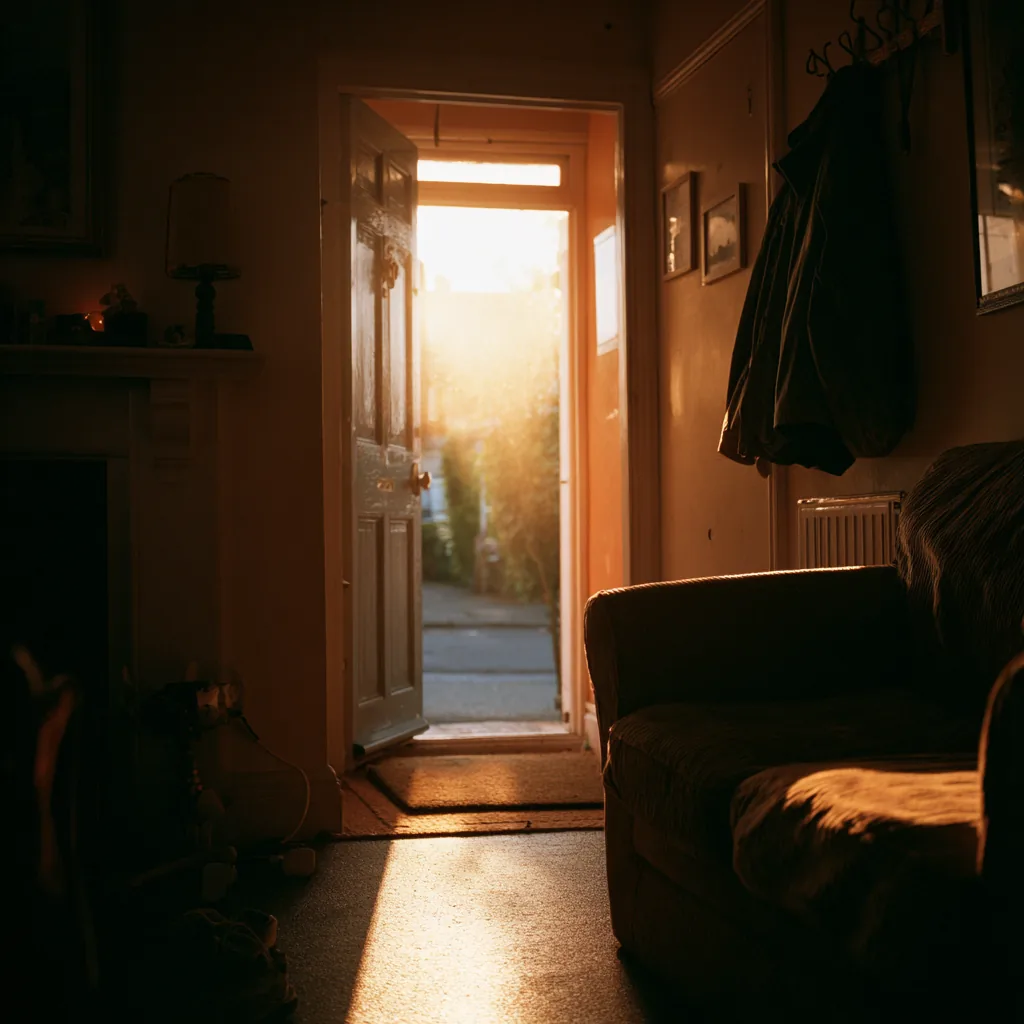
Nobody tells you what happens to the house. There's guidance for everything else — registering the death, the funeral, who needs to be informed — and then someone hands you your dad's front-door keys in a clear plastic bag with a printed label on it, and the guidance runs out.
So here it is, in order.
For a while, the house isn't yours
When someone dies alone and isn't found for a time — the phrase you'll hear is an unattended death — the house stops being an ordinary house for a few weeks. The police attend first. Then the coroner's office decides whether it needs to understand more about how the person died.
Until the coroner is finished, the house sits in a kind of pause. You may be asked not to move anything. Some days you may not be allowed in at all.
That pause can feel like obstruction. It isn't. It's the one part of all this that has rules, and the rules exist so that no question about your dad's death goes unanswered later.
Part of you is desperate to get inside. Another part is quietly relieved that someone has said you can't yet. Both of those are real, and neither one needs explaining to anybody.
One name to write down
You'll deal with more people in a fortnight than feels reasonable. The one to hold onto is the coroner's officer — a named person whose job includes talking to families. They can answer the question underneath all your other questions: when.
The funeral director will guide the arrangements, the same as any other death. What's different is the house itself. Where someone wasn't found for a time, one room usually needs specialist attention before the house can be lived in, cleared or sold.
Please don't do that room yourself. Not because anyone will stop you — because what a death leaves behind can reach into floorboards and soft furnishings, and it can carry real health risks. Whatever else you take on yourself in the weeks ahead, don't take on that room.
If the waiting itself becomes the heaviest part, that's worth saying out loud too — to your GP, or to Cruse Bereavement Support. The house can wait. You matter more than it does.
The day it becomes yours again
Then, quite suddenly, on an ordinary weekday, the coroner releases the house. No ceremony. A phone call, sometimes a letter. The house stops belonging to the process and starts being your dad's house again — and yours to decide about.
That's usually when families call us. Our end of life cleaning work is the bridge between those two moments: we make the affected room safe, clean and ordinary again, so that the house can go back to being a house. The team is trained and insured for exactly this work.
We also arrive in unmarked vehicles. The street learns nothing you haven't chosen to tell it.
The first thing families ask us at the door is almost never about the room. It's "Can I open the windows now?" They've spent weeks being told not to touch anything. Being allowed to let air in is the first piece of the house they get back.
Everything after that — the cupboards, the paperwork, the deep clean before the house is handed on — happens at whatever pace you set. Some families want it all done in a week. Some come back to it months later. There's no correct speed.
If you're here because the death was expected — a hospital or hospice death, with a property simply waiting to be cleared rather than a coroner involved — our guide to end of life property cleaning is closer to what you need.
You don't have to be the first one through the door
Nothing about the house needs deciding today. The keys can stay in that plastic bag on your kitchen table for as long as the process runs — and honestly, for a while after.
But if today isn't the day, pick the moment that will be — after the funeral, after the coroner's call, whenever it comes. Put our number in your phone now, so it's already there when that moment arrives: 01933 213045 — it'll keep until the house is yours.
And when that day comes, you don't have to be the first person through the door. We can be.