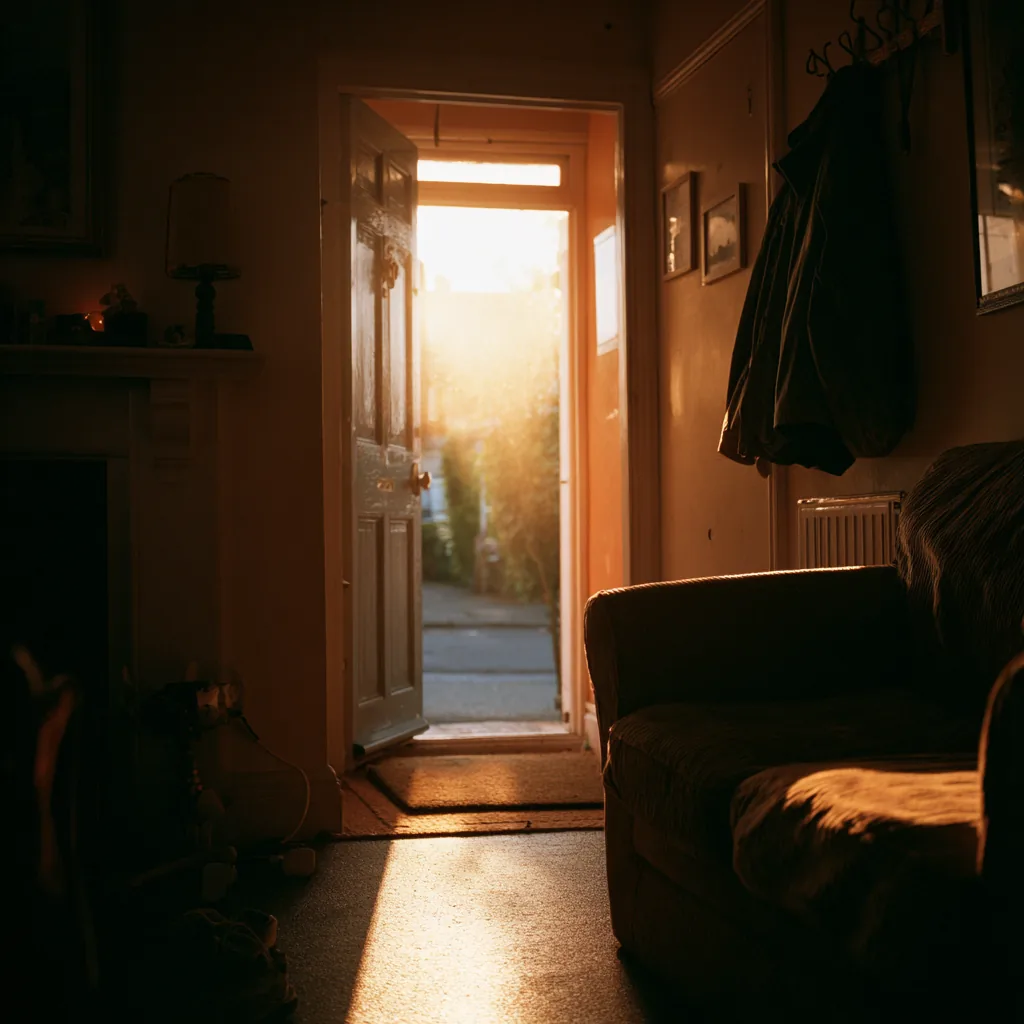
Why can one small thing stop you cold?
You've cleared a whole shelf today. There are bags by the door, ready for the charity shop. Then you pick up one more object to add to the pile — and your hand just doesn't. You stand there holding it. The rest of the room waits.
It might be a biscuit tin. A single glove. A watch that stopped years before he did. Nobody else would look at it twice. You still can't put it down.
It was never about the object
The thing in your hand isn't worth anything. That's not why it won't go.
You're not holding an object. You're holding the last ordinary morning. A smell that hasn't quite left it. A version of them the rest of the house has already started to forget.
You can grieve a thing — because it was never the thing you were grieving.
The relief, then the panic an hour later
Two pulls, taking turns. Get the house finished. Keep her in every drawer.
The relief of filling a bag comes first. The worry that you moved too fast comes about an hour later. Neither one is wrong.
That tug-of-war isn't you failing at this. It's grief looking for somewhere to live.
What happens to the box
This is the part where families expect us to disagree with them. To gently suggest the watch could really go now.
We don't. The box you can't open today gets set aside — kept safe, left exactly where you want it. The work moves around it. The rest of the room gets cleared; the one thing you're not ready for doesn't.
Keeping one thing isn't hoarding, and it isn't a problem to be managed. A whole home cleared and one box kept is a job finished, not a job half-done.
Nearly everyone has a "not that" before we've taken our coats off. They name it before we can ask. They tell us at the door which one thing isn't up for discussion — and it's usually the smallest thing in the room.
There's almost always a box, too, that never gets opened on the day. It just moves with the person — the hall, the kitchen, the back seat of the car — looking for somewhere safe to be put down. That's allowed. Not everything has to be decided this month.
Most end of life cleaning work runs over two to six visits rather than one long day, exactly so nothing has to be rushed. And the things you do let go of leave properly — we're licensed waste carriers, so what goes is handled with the same care as what stays.
If you're measuring yourself against how long all of this is taking, our guide to how long clearing a home really takes might lift some of that weight.
You don't have to let it go to begin
That's the part most people have backwards. They think they have to be ready to part with everything before they can start. You don't.
You went looking for how to do this without forcing it. Something in you has already decided the box can stay — you just wanted permission to clear around it. Consider it given.
When you're ready, you won't need a speech. Most people open with "I don't know where to start." That's a perfectly good place to start. We take it from there.
And if today isn't the day, that's an answer too. Put the number somewhere it'll be waiting for the day that is.
Call us on 01933 213045 — the things you can't part with stay exactly where they are.